
About this studio
Yes, adults can learn cello in Singapore.
I have been teaching cello since 2003. Since 2018, I have worked exclusively with teens and adults. Most students come with no music background. Some are returning after years away. What they share is a genuine desire to learn properly.
I keep a small number of students intentionally. Teaching here is not just about technique. It is a personal development process that happens to be facilitated by an instrument I have played for over four decades.
Building from the ground up
Complete beginners, returning players, or those who have had lessons elsewhere and felt something was missing. We work at your pace, with your goals.
Focused coaching
You already play, but there is a specific area you are struggling with. Perhaps technique, posture, tension, or a passage that will not come together. How long we spend on it depends on the issue.
Your teacher
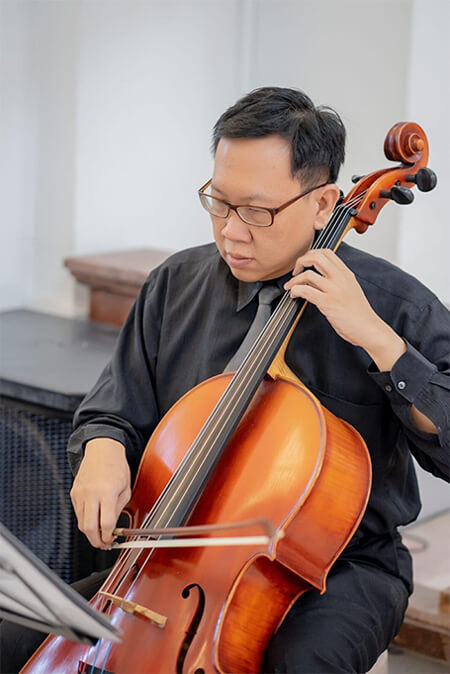
Chin Hong
I started on the cello at 13 and began teaching at 18. Over the years I have served as principal cellist at several orchestras, coached the NTU String Orchestra cello section, taken part in a masterclass under Yo-Yo Ma, and founded Gracenotes, one of Singapore's earliest string quartets.
- ·Teaching cello since 2003
- ·Teens and adults only since 2018
- ·Cello sectional coach, NTU String Orchestra
- ·Masterclass participant under Yo-Yo Ma
- ·Founder, Gracenotes String Quartet
- ·Principal cellist at multiple Singapore orchestras
Each session
What a cello lesson looks like
Each lesson is one hour. I typically move through four segments, though sometimes the most useful thing is to slow down and spend the whole session on one or two things. Covering ground matters less than retaining what you have learned.
01
Review
What you worked on since the last session, difficulties you ran into, and questions you have.
02
Foundation Work
Bow technique, scales, and studies. This is where the fundamentals are built and reinforced.
03
Repertoire
Pieces suited to your level and goals. What this looks like depends entirely on where you are.
04
Reflection
A short recap of the lesson and what to focus on before next time.
This is a guide, not a script. A lesson needs to deliver a specific learning outcome, and sometimes reaching that outcome means going deep into one thing. Surface coverage across several areas is rarely as useful as genuine depth in one. I will always follow the thread that matters most in that session.
Realistic expectations
How quickly will you progress?
Progress varies by person. The figures below assume three lessons a month and two to three hours of practice each week.
6 to 8 months
Grade 2 to 3 standard
Assuming 3 lessons a month and 2 to 3 hours of practice each week. Most of the work goes into coordination, intonation, and building the right habits from the start.
12 to 24 months
Grade 3 to 5 standard
By this point most students can play pieces independently and begin to bring something of their own into the music.
No exams are required. I use grade levels as benchmarks for progress, not as targets to chase. Some students sit ABRSM or Trinity exams. Others never do. Both are perfectly fine.
Getting started
How lessons begin
Every student starts the same way.
Step 1
Trial lesson
I do not take on any student without a trial lesson first. A great learning experience needs genuine fit between how I teach and how you learn. The trial is how we both find that out.
Optional
Accelerated Learning
For new adult beginners who want to move faster, I offer an Accelerated Learning programme aimed at reaching Grade 3 standard within one to two months. It requires significantly more time and commitment. I only offer it after the trial lesson, and only when I think it is right for you.
Students
What students say
“If you were someone like me without any music training background yet fascinated with the unique beauty of cello music and wish to pick up the instrument, Chin Hong is a good teacher to start with your cello journey. He is very patient and encouraging. During his lessons, I'm not just learning the techniques of cello playing, I'm learning myself as well.”
“He does not focus solely on grades and exams but more on techniques and foundations which I believe allows one to excel faster in the long run. Within two years I have obtained an ABRSM Grade 5 in cello, gained confidence to play in the NTU Training Orchestra and also had the opportunity to perform at a recital organised by Chin Hong and his Wife.”
Common questions
Frequently asked questions
Can adults learn cello?
Yes. I have been working with adult beginners since 2003. Over the years I have developed teaching and learning materials specifically for adults, because adults and children are at very different stages of life and need to learn things in different ways. Age is not the deciding factor. What matters most is whether you can commit to regular, deliberate practice between lessons.
How long does it take to learn cello as an adult?
With three lessons a month and two to three hours of practice each week, most adults reach Grade 2 to 3 within six to eight months. Grade 3 to 5 is achievable within 12 to 24 months. Progress depends on how consistently you practise, not how old you are.
Do I need to own a cello before starting?
Finding a good instrument to rent in Singapore is not straightforward. For someone who is completely new, I will see if there is a spare instrument you can use during the trial lesson. Beyond that, owning your own cello matters. It is central to your progress, and there is no way around it. That conversation happens after you have decided to commit. For buying, Carousell is a good starting point for decent second-hand instruments at a reasonable price, and I can advise on what to look for.
Do I need prior music experience?
Having some music background is always useful. But not having it simply means there are additional skills to pick up along the way. Either way, it is a learning process, and I work with where you are.
Are exams required?
No. I use ABRSM and Trinity grade levels as progress benchmarks, not requirements. Some students choose to sit exams. Others never do.
Is it too late to learn cello as an adult?
No. I work with adults who come with all kinds of challenges: physical, mental, work schedules, family commitments. What I have found is that if you are willing, you will find a way. That willingness matters far more than age. Learning music, not just the cello, is also a genuinely good way to keep developing your mind and your mental flexibility as an adult. That is something I have seen again and again.
Start with these articles
Answers to the questions I hear most often.

Ready to start?
Send me a WhatsApp message. Tell me where you are with cello and what you are hoping to do. I will take it from there.
WhatsApp Chin Hong